Wood
Wood Fence Installation
Natural beauty and real privacy, in picket, privacy, board on board or decorative boundary styles, built to match the property it stands on.
Chapter 01
Picket, privacy, board on board, decorative boundary
Four wood styles cover almost every reason someone puts up a wood fence, and knowing what each one is actually for makes the decision much easier than picking from a photo.
A picket fence marks a boundary and dresses up a front yard without hiding anything behind it. A privacy fence closes a back yard off completely, board tight against board. Board on board is a privacy fence built with the boards overlapping on alternating sides, so there is no gap to see through from either direction, which most people find is worth the extra material. A decorative boundary fence sits somewhere between picket and privacy, marking a line with more presence than a picket but without shutting the view down entirely.
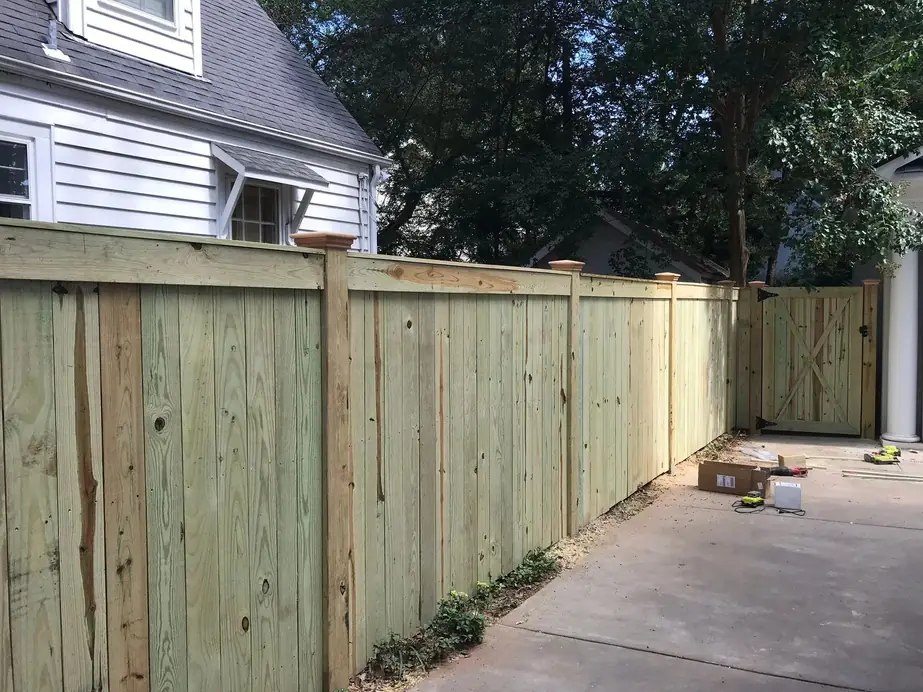
Wood privacy fence with decorative post caps and a matching gate installed by Crown Fence
Wood is the most customisable fence we build
Height, board spacing, post cap detail and the gate itself can all be adjusted on a wood fence in a way that is much harder to do with a manufactured aluminum or vinyl panel. A taller run for privacy near a neighbour's window, a slightly wider gate for equipment access, or a decorative cap style that matches the house, all of it gets decided at the build rather than picked from a fixed catalogue.
That flexibility is also where a fabrication shop earns its keep. A gate built to match the exact board spacing and cap detail of the rest of the run looks like one fence, not a fence with a mismatched gate bolted onto it.
Chapter 03
Blending with the property rather than fighting it
Wood has a timeless appearance that works against a traditional house and a modern one equally well, which is not true of every fencing material. A horizontal board on board run reads as contemporary, while a classic picket line reads as traditional, and both are built from the same material with a different spacing and orientation.
That is why wood is often the answer when a property has a mix of styles on it, an older house with a newer addition, or a boundary that needs to look right from more than one angle.
Privacy is a height and spacing question
How private a wood fence feels comes down to two decisions: how tall it stands and how tight the boards sit against each other. A full height board on board run with no gaps is the most private option available. A shorter picket fence with visible gaps offers almost none, by design.
There is no single right height or spacing for every yard. What matters is matching the choice to what the fence actually needs to block, whether that is a neighbour's sightline, a street, or nothing more than marking where the property ends.
Crown Fence builds wood fencing in house at the Statesville shop. Insured. Lifetime warranty on qualifying non-wood fencing products. Call (704) 883-8480.
The four styles
What to ask for, and what it actually gives you
- Picket. Marks the line, keeps the yard visible, the most traditional front yard style.
- Privacy. Boards set tight, closes the yard, the standard back yard choice.
- Board on board. Overlapping boards on alternating sides, no gap to see through from either side.
- Decorative boundary. More presence than a picket, without shutting the view down entirely.